Before the Home Screen: Public Screens in Shared Places
Public screens in shared places shifted from fixed notices to changing displays. Learn how each approach serves a crowd and what shapes its role.
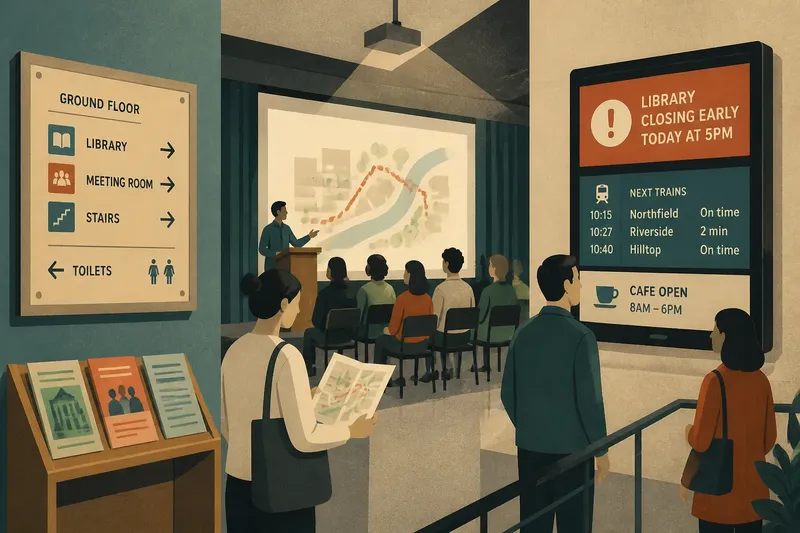
The common mistake is to treat public screens as home televisions made larger. That misses what they cost a shared place: attention, clarity and room for people to act on information. Public screens in shared places have served different purposes as the ways of displaying information changed, from fixed announcements to projections and electronic displays.
The useful distinction is not simply old technology versus new. It is whether a display preserves a message, gathers people around a moment, or updates information as circumstances change. Each approach suits a different relationship between a place and its visitors.
Notices that stay put
A printed notice, painted sign or fixed board gives a public place a durable message. A station can identify a platform; a library can post opening information; a community hall can display an event programme. The content does not change just because someone passes by, and the reader can look when convenient.
This approach works best when the information is stable and the visitor needs to consult it at their own pace. The material and placement carry much of the communication. A large typeface, plain wording and a clear location help people find the message without having to wait for it to appear.
Its limitation is equally plain. If a notice becomes outdated, the old message may remain visible until someone replaces it. A board can also collect competing announcements, leaving visitors to decide which one applies. The display itself does not distinguish the urgent from the merely present; its organisation must do that work.
Fixed notices suit places where people arrive at different times and need a dependable reference. Keep a changing message off a surface that is hard to update.
Projections as events
Projection made a display less like a notice and more like a shared occasion. Images could occupy a wall, screen or other broad surface, allowing a group to watch the same material together. In a hall, public meeting or civic gathering, the projection could show a speaker’s words, a map or a sequence of images to people who could not all see a small original.
The role was social as much as informational. A projected image asks people to orient towards a common point. It can support a presentation or performance, but it is not automatically a useful public sign. The audience may have to arrive at a particular time, remain in a particular area and pay attention while the image is present.
Projection suits planned gatherings, especially where a person or programme can guide the audience through the material. It is less suitable as the only source of information for visitors who are arriving late, moving through the space or looking for one particular instruction. In those situations, a printed programme or sign can remain available after the projection moves on.
Say a neighbourhood hall is hosting a public meeting. The organisers put a map on a large shared surface while someone explains proposed changes, then leave a printed copy by the entrance. Visitors in the room can follow the explanation together; those who arrive later can still inspect the map without needing to catch up with a projection.
Screens that can change
Electronic public displays brought another role into shared places: information that could be revised without replacing a physical sign. A display in a station, shop, waiting area or civic building might show a recurring announcement, a current service message or several items in sequence. Its defining feature is not movement or brightness, but the ability to present different content over time.
That flexibility changes the editorial problem. A fixed notice gives one message a stable presence. An electronic screen can rotate messages, respond to changing conditions or show different material in different parts of the day. But a visitor who sees only a brief portion of that sequence may miss the item they need. A changing screen can make information current while making it less continuously available.
Electronic displays suit places where information genuinely changes or where several messages need to share a limited surface. They are a poor substitute for a stable sign if visitors must be able to read one instruction at any moment. The most legible systems often pair a changing display with a fixed label, directory or printed reference.
The change also affects who controls the message. A notice can be written and posted by the people responsible for a room. An electronic display usually depends on an operator, a content process and a decision about what appears first. The screen may be visible to everyone, while the ability to update it belongs to a small group.
Choosing a public role
These approaches are not stages in which each new form makes the previous one useless. A public place may need all three, because visitors use it in different ways. The choice should follow the job the information has to do:
- For a lasting reference: use a fixed notice or sign when the message stays valid and visitors need to consult it at any time.
- For a shared explanation: use projection when a group will gather and someone can present or interpret the material.
- For changing information: use an electronic display when updates matter and the content can be made readable during a visitor’s time in the space.
- For mixed needs: combine forms, keeping essential directions available in a stable format while using a changing display for updates.
Imagine a public library that holds events, posts room directions and announces temporary service changes. A notice near the entrance can show the enduring room guide; a projection can support an event talk; an electronic display can carry a current closure message. The expected result is that visitors can find routine directions without waiting, follow a presentation together and see time-sensitive information in the place where it matters.
Choose by asking what a visitor should be able to do after seeing the display. If the answer is “remember where to go”, favour a stable sign. If it is “understand this with the group”, projection may suit. If it is “know what has changed”, an updateable screen may help, provided the message remains available long enough to read.
Questions about public screens?
What counts as a public screen?
It is a display intended to communicate in a place used by people beyond a private household, such as a station, hall, shop or library. The term can include fixed signs and projected images as well as electronic screens.
Why did electronic displays change public information?
They made it possible to replace or rotate displayed content without changing a physical sign. That can help with changing conditions, but visitors may not see every item in a sequence.
Are projections useful for everyday directions?
They can help explain a route to a gathered group, particularly when a speaker can point out details. For directions people need at different times, a fixed sign or directory is usually easier to consult.
How can a place combine display types?
Keep essential, stable information available on a sign or printed board, and reserve projection or electronic displays for material that benefits from a shared presentation or timely updates. This gives visitors more than one way to get the message.
Attention belongs to the place
A public display does more than carry words or images. It shapes how people pause, gather, move on or look for help. A fixed board asks the visitor to approach it; a projection asks a group to attend together; an electronic screen can place updates within an ordinary route through the building.
That is why the history of public screens is also a history of changing public roles. The shift was not simply from paper to light. It was from messages that waited in place, to images shared at an appointed moment, to displays able to change alongside the activity around them. For public screens in shared places, the best choice remains the one that gives visitors the right information in the way the place asks them to use it.